
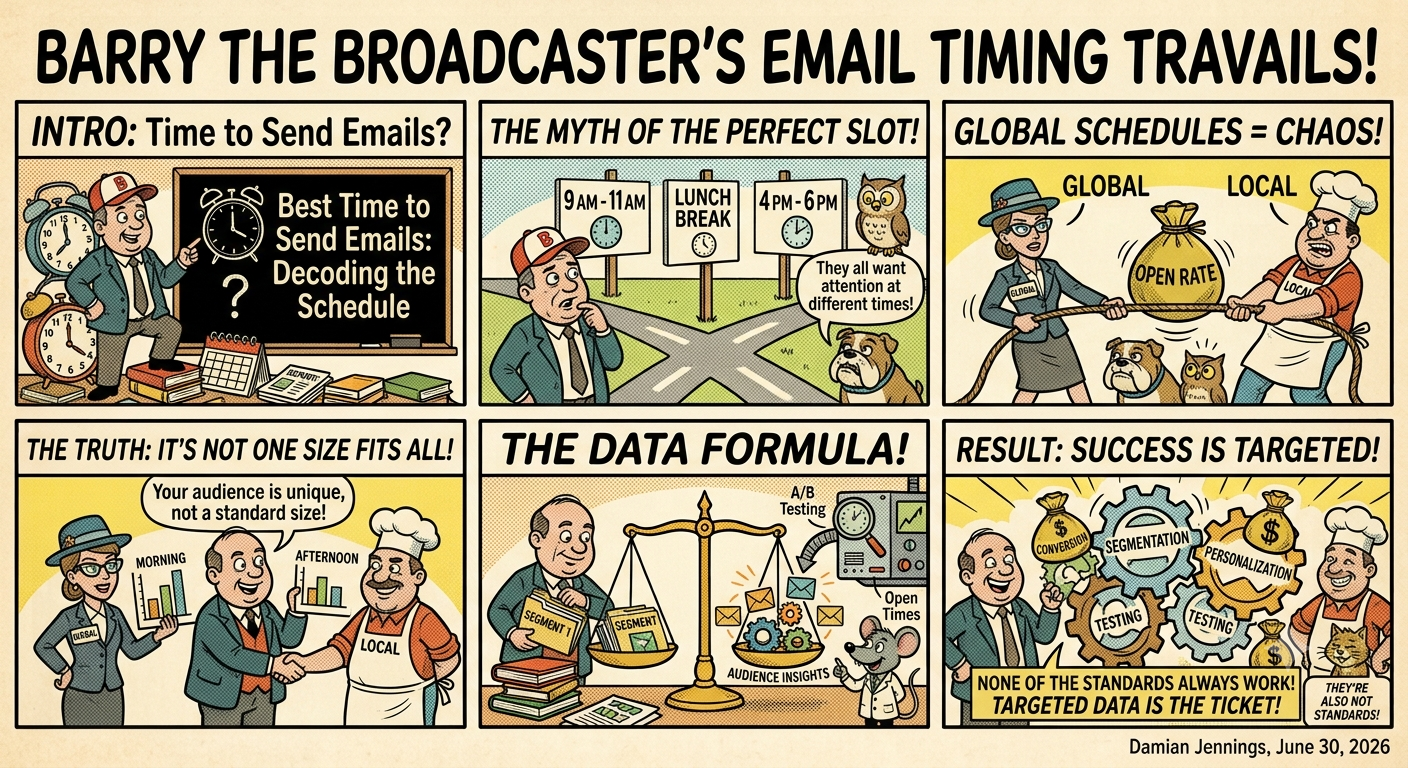
The standard answer to “when should I send marketing emails” is Tuesday or Thursday, around 10am. It’s in every guide, it’s based on real aggregated data, and for your specific list and your specific audience it’s probably wrong.
Why the advice exists
Email platforms have enormous datasets. Across millions of campaigns, mid-week mornings do outperform Monday mornings and Friday afternoons on average. Those averages are real.
But an average across every industry, every audience, and every type of email tells you very little about yours. B2B emails to finance directors don’t behave like B2C emails to gym members. Restaurant offer emails don’t behave like software renewal reminders. The average flattens all of that into a single recommendation that fits almost nobody precisely.
What actually moves open rates
Before you spend time optimising send time, make sure the bigger variables are right. Subject line is the single largest driver of whether someone opens your email, a compelling one at 9pm Friday will outperform a dull one at 10am Tuesday, every time. Sender name matters too: people open emails from people they recognise. List quality matters more than either of those, an engaged list opens at any hour; a purchased or stale one won’t respond regardless of when you send.
If those aren’t working yet, timing optimisation is noise.
How to find your actual best time
Test it. Most platforms let you split a campaign, send half at 9am, half at 7pm, or split Monday versus Thursday. Run it across several campaigns, not just one. Look at open rates, click rates, and ideally conversions. Patterns specific to your audience emerge over time.
Also look at your existing data. Check when your opens actually happen. If 60% of opens land within two hours of sending, and those cluster at a particular time, that’s your list telling you when it’s active. Listen to it.
Rough patterns worth knowing
Without testing, B2B audiences tend to respond best mid-week, mid-morning (8–10am) or just after lunch. Monday mornings are for clearing inboxes, not reading newsletters. Friday afternoons are for mentally clocking off. B2C audiences are more variable, evenings and weekends can outperform business hours, particularly for anything impulse-driven. For e-commerce, Thursday or Friday sends can pull forward weekend purchases.
Starting points, not conclusions. Your list may behave completely differently.
Time zones and consistency
If your list spans time zones, “10am” needs qualifying. Most platforms can send based on the recipient’s local time, use it if you have an international list. Sending a “24 hours only” offer at 3am is less persuasive than it sounds.
On consistency: your subscribers learn when to expect you. If you send every Tuesday at 9am, some people start opening it because they’re used to seeing it then. Constantly moving your send time chasing marginal improvements disrupts that. Find something that works reasonably well and stick to it. A predictable Thursday email will usually outperform a perfectly optimised one that arrives at random intervals.
The short version
There’s no universal right answer. Tuesday 10am is a reasonable guess if you have nothing else to go on. But the correct answer for your list comes from your own data and your own tests, not from whoever wrote the guide you just read. Sort subject lines and list quality first. Then test timing. In that order.