
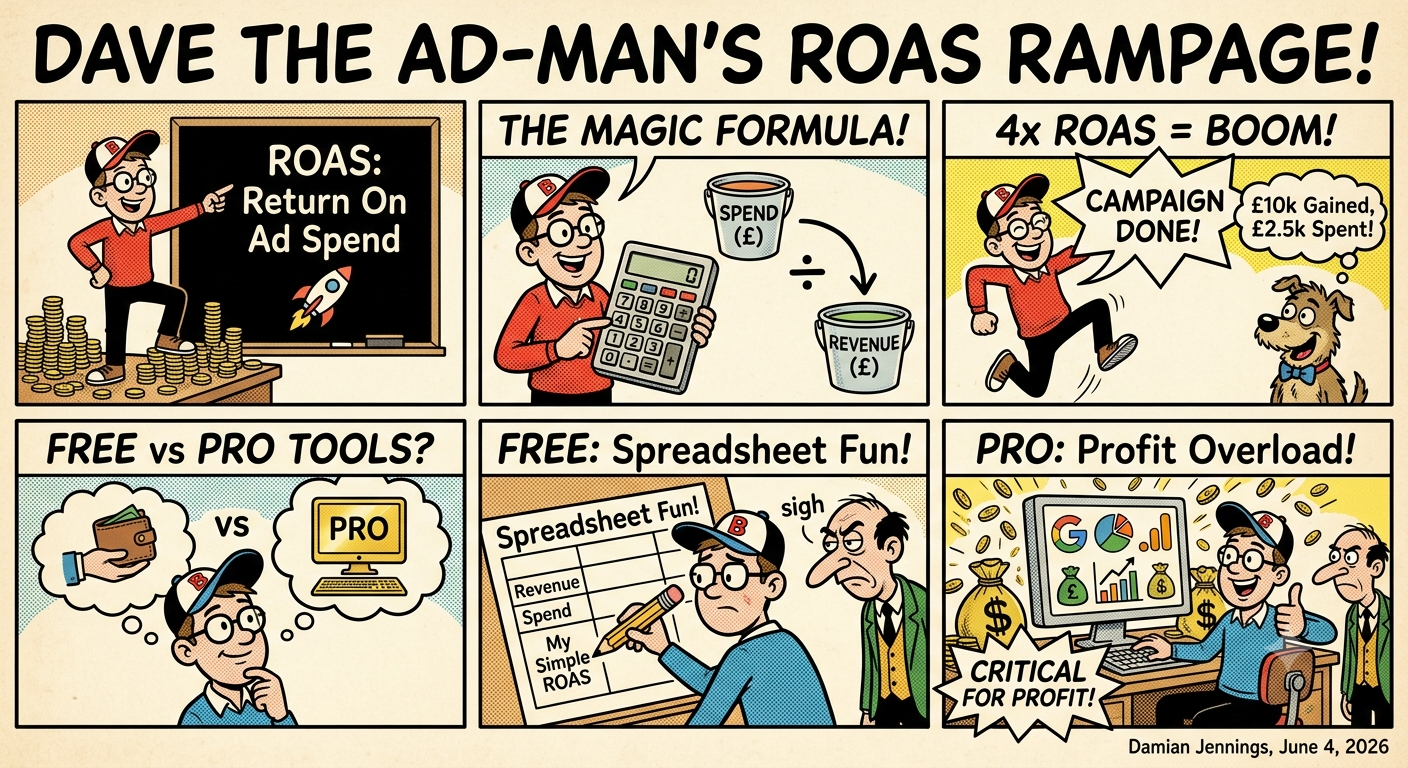
ROAS stands for Return on Ad Spend. Revenue divided by ad spend. A £2,500 campaign that brings in £10,000 is a 4x ROAS. Simple maths.
The question everyone asks is: what’s a good ROAS? The honest answer is that it depends entirely on your margins, and anyone who quotes you a number without knowing your business is making it up.
The 4x myth
4:1 gets cited constantly as the benchmark for a “good” ROAS. It’s repeated so often it feels like fact. It isn’t.
A 4x ROAS is profitable for some businesses and loss-making for others. The difference is margin. If you sell something for £100 that costs £80 to produce and ship, your gross margin is 20%. A 4x ROAS means you spent £25 to generate £100, leaving £20 gross profit before covering the ad cost. You’ve spent £25 to net £20. That’s not a marketing win, that’s a slow bleed.
Flip it: a digital product at 90% margin turns that same 4x ROAS into £90 gross profit on £25 spend. Completely different picture. Same ratio.
The benchmark is useless without the margin.
How to calculate the ROAS you actually need
Start here: break-even ROAS = 1 divided by your gross margin.
40% gross margin gives a break-even ROAS of 2.5. Below that and you’re losing money on every sale before you’ve paid for anything else. Above it, you’re covering goods and ads, but you still need to cover overheads, returns, and payment processing on top of that. So your real target ROAS sits meaningfully above break-even, not just barely above it.
Work it out from your actual numbers. Don’t borrow someone else’s.
Blended ROAS vs channel ROAS
Every ad platform will tell you its ROAS is excellent. Google will claim the sale. Meta will claim the same sale. If the customer touched both before buying, both count it as a win, and your combined reported ROAS is meaningfully higher than what actually happened.
Blended ROAS cuts through this. Take your total revenue. Divide by total ad spend across all channels. That’s your real number. £50,000 revenue on £12,500 in ads is a 4x blended ROAS, regardless of what any individual platform reports.
Use individual channel ROAS to make directional decisions. Use blended ROAS to know if you’re actually making money.
When ROAS is the wrong metric
ROAS measures revenue. Revenue is not profit. A high-revenue, low-margin business can have a strong ROAS and thin profits. If you’re running promotions or selling loss-leaders to acquire customers, ROAS will look healthy while your bank account disagrees.
And if you’re in a subscription model, or any business where customers buy repeatedly, a “bad” ROAS on the first transaction might be completely sensible once you factor in what that customer is worth over two years. ROAS alone doesn’t capture that. It needs context.
The short version
ROAS = Revenue ÷ Ad Spend. Good ROAS = whatever covers your costs and leaves something worth having, based on your actual margin. Calculate your break-even from gross margin. Set your target above it. Track blended ROAS instead of believing what each platform tells you. And if your margins vary by product or your customers buy more than once, ROAS is only part of the story.