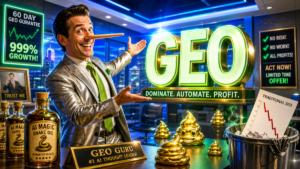
If GEO wasn’t enough, the SEO industry has now produced AISEO — AI Search Engine Optimisation. Also AEO. Also AIO. Also LLMO, LLMSEO, and several others that arrived while I was writing this sentence. They all describe the same thing: optimising your content to appear in AI-generated answers from tools like ChatGPT, Perplexity, and Google’s AI Overviews.
GEO covered this ground already. The short version: these systems pull from existing web content, synthesise it, and present it conversationally. The content that gets cited is the content that’s clear, trustworthy, and actually good. That’s SEO. It has always been SEO.
AISEO is GEO with a different acronym. The fact that the industry needed a second one for the same idea is the tell.
What AISEO actually recommends
The AISEO playbook, as presented by the consultants selling it:
- Structure content with FAQ schema and question-based headings — featured snippets optimisation, been around since 2016
- Write concise, quotable answers AI can lift verbatim — same thing
- Establish clear entity definitions across your digital presence — basic on-page consistency
- Build brand mentions across authoritative sources — link building and PR
- Use structured data markup — technical SEO
- Maintain accurate, consistent information about your business — basic content hygiene
If this looks familiar, it should. It’s the same list from every GEO explainer, which was the same list from every E-E-A-T explainer, which was the same list from every SEO fundamentals guide published in the last ten years. The only thing that changes is the acronym at the top.
The acronym problem
There are now at least five terms in active use for “optimise your content for AI systems”: GEO, AEO (Answer Engine Optimisation), AIO (AI Optimisation), AISEO, and LLMO (Large Language Model Optimisation). Different agencies favour different ones. Different tools brand themselves around different ones. Articles explain the differences between them as though the differences are meaningful.
They aren’t. The proliferation of acronyms isn’t evidence of a rich new discipline. It’s evidence of a lot of people trying to own a term. Every new acronym is another opportunity to position yourself as the expert in something that didn’t exist last quarter, and another opportunity to make a client feel like they’re falling behind.
Does being cited in AI answers even matter?
This is the question nobody selling AISEO services wants you to ask too carefully.
AI citations don’t work like search rankings. When you rank number one on Google, someone clicks your link and arrives on your site. When ChatGPT mentions your brand in an answer, the user may or may not follow up. In many cases they don’t — the AI answered their question and they moved on. The conversion path from “AI mentioned us” to “customer bought something” is considerably less direct than organic search traffic.
For brand awareness, appearing in AI answers has real value. For driving measurable traffic and revenue, the evidence is thin. The businesses that benefit most are those in categories where people ask AI for direct recommendations — and even there, the link between citation and purchase is largely unproven at scale.
The one thing that is real
The underlying shift is genuine, even if AISEO isn’t the solution. AI systems are handling more informational queries without sending users anywhere. That traffic is gone and it’s not coming back.
But the response to that isn’t a new optimisation discipline. It’s a strategic question about which queries are worth targeting — the kind where AI gives a complete answer, or the kind where someone still needs to click, read, compare, and decide. The latter category is larger than the hype suggests, and that’s where SEO still wins, with or without a new acronym attached to it.
What to actually do
Ignore AISEO as a distinct discipline, just as you should ignore GEO. The tactics it recommends are standard SEO. Run them because they produce good content and build real authority — not because they come with new branding.
If you want your brand mentioned in AI answers, focus on what has always driven visibility: get referenced by credible sources, keep your information accurate and consistent across the web, produce content that directly addresses the questions your customers are actually asking. That’s PR and SEO. It doesn’t need a new name.
The SEO industry will keep producing acronyms. The work behind them will keep being the same.