
Paid advertising is the closest thing digital marketing has to a tap you can turn on and off. Need more enquiries this month? Run ads. The trade-off is that the moment you stop paying, the traffic stops. But used correctly, paid ads are one of the most powerful tools available, particularly for businesses that need results faster than SEO can deliver them.
This covers Google Ads and Meta ads (Facebook and Instagram) — the two platforms that account for the vast majority of digital ad spend, and the two most relevant for most businesses.
When paid ads make sense
Paid advertising works best when you need results quickly and SEO timelines aren’t acceptable. When you’re testing something new (a product, a market, an offer) and you want real data fast. When your margins support a meaningful cost per acquisition. When you have a seasonal push and need to capitalise on demand that SEO can’t capture fast enough. When you’re a new business with no organic presence yet and you need traffic while the longer-term work compounds.
What it’s not good for: building long-term assets. Everything you spend on ads is spent. The moment the campaign ends, the traffic ends with it.
Google Ads vs Meta Ads
These platforms work differently, and most businesses should think about which problem they’re solving before choosing one.
Google Ads captures existing intent. Someone searches “emergency boiler repair London” and your ad appears. They were already looking; you just need to be there. High intent, ready to act. The downside is that if nobody is searching for what you offer, there’s no intent to capture.
Meta Ads creates intent. You show your product to people who fit a target profile before they’ve thought to search for it. Better for brand awareness, reaching cold audiences, and retargeting people who’ve shown interest. Lower intent at the point of exposure, but powerful for building the consideration that eventually leads to a search — or a direct purchase.
| Google Ads | Meta Ads | |
|---|---|---|
| How it works | Captures search intent | Creates awareness and intent |
| User mindset | Actively looking for something | Scrolling, not looking |
| Best for | High-intent purchases, services, local | Brand building, visual products, retargeting |
| Speed to results | Fast if search volume exists | Moderate (needs creative testing) |
| Main risk | Bidding on the wrong keywords | Audiences too broad or creative too weak |
How Google Ads actually works
Google Ads runs on an auction. Every time someone searches, Google runs an instant auction among advertisers bidding on relevant keywords. You don’t just pay the most to win — Google uses a Quality Score (based on ad relevance, expected click-through rate, and landing page experience) to determine ad rank. A highly relevant ad with a good landing page can outrank a competitor who’s bidding more.
The main campaign types: Search (text ads triggered by keywords), Shopping (product listing ads for e-commerce), and Performance Max (Google’s AI-driven campaign type that serves across all Google inventory). For most small businesses starting out, Search campaigns targeting specific keywords related to your services are the place to start.
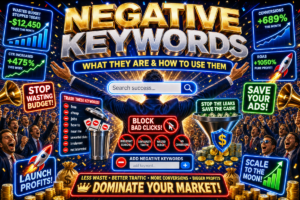
Keyword match types matter. Broad match gives Google maximum flexibility to show your ad for related queries — useful for reach, dangerous for wasted spend. Phrase match and exact match give you more control. Negative keywords are equally important: they tell Google what not to show your ad for. If you’re a premium service, “cheap” and “free” belong in your negative keyword list.
How Meta Ads actually works
Meta Ads targets people by who they are rather than what they’re searching for. You define audiences by location, age, interests, behaviours, and — most powerfully — by similarity to your existing customers (lookalike audiences) or by retargeting people who’ve already interacted with your brand.
The creative is doing most of the heavy lifting on Meta. The algorithm is increasingly good at finding the right people; what it can’t do is make a weak ad compelling. Static images, video, and carousel formats all work — the right format depends on your product and what you’re trying to achieve. Test multiple creative variations and let performance data tell you what’s working.
The Meta pixel (now called the Meta Pixel or Conversions API) is non-negotiable. Install it on your website before you run any ads. It’s what allows Meta to optimise for conversions, build retargeting audiences, and create lookalikes. Running Meta ads without it is burning money.
Budget guidance
There’s no universal right answer, but a practical floor for meaningful learning: £20–30 per day per campaign. Below that, the algorithms don’t get enough data to optimise effectively and you’ll spend months learning very slowly. Set a budget you can sustain for at least 90 days — the first month is largely data collection, the second month is where real patterns emerge, and the third month is when you have enough to make informed decisions.
Start small, prove the model, then scale. A £500/month test that shows a 3x return tells you something important. Scaling to £5,000/month on that basis is rational. Scaling blind is how businesses burn budget they can’t afford to lose.
Realistic timelines
Weeks 1–2: setup, launch, initial data collection. Don’t judge performance yet — there isn’t enough of it.
Weeks 3–6: the algorithm learns. Performance often improves meaningfully as the system builds data on what converts.
Months 2–3: a clear enough picture to know what’s working and what needs changing. This is when real optimisation starts.
Month 3 onwards: systematic optimisation and, where the data supports it, scaling.
What most businesses get wrong
Running ads without a clear conversion mechanism on the other end. Traffic from an ad lands somewhere — if that somewhere doesn’t convert, the ad is wasted regardless of how well it performs. Ads and landing pages are a system, not separate components.
Judging performance too early. The first two weeks of a campaign are data collection, not results. Businesses that pause after a week because they haven’t seen returns are paying for the learning phase and not benefiting from it.
Not understanding attribution. Google will claim credit for sales that Meta also influenced. Meta will do the same in reverse. Look at blended metrics — total revenue versus total ad spend — rather than trusting what any individual platform dashboard tells you. The platforms have a financial incentive to show you numbers that make them look good. They do.
What good tracking looks like
At minimum: Google Analytics connected, conversion goals set up (form submissions, phone calls, purchases), and the appropriate platform pixel installed. For Google Ads, connect your Google Ads account to Google Analytics for richer conversion data. For Meta, implement Conversions API alongside the pixel to capture conversions that browsers block with privacy settings.
Understand the difference between last-click attribution (which over-credits the last ad someone clicked before converting) and data-driven attribution (which distributes credit more realistically across the customer journey). Most platforms default to something favourable to them. Set up attribution in a way that gives you a realistic view, not a flattering one.
Getting started
Start with the platform that matches your intent. If people are already searching for what you offer, Google Ads. If you need to reach people before they’re searching — because the product is new, awareness is low, or you’re building brand — Meta. Set a budget you can sustain for 90 days. Track properly from day one. Optimise from data, not instinct.
How much should I spend on Google Ads?
A practical minimum for meaningful data is £20–30 per day (£600–£900/month). Less than this and the algorithm doesn’t learn fast enough and your sample sizes are too small to draw conclusions. Start there, prove the return, then increase budget where the data supports it.
What’s a good ROAS for Google Ads?
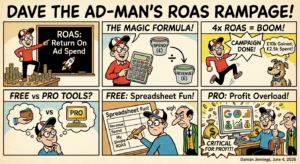
There’s no universal good ROAS — it depends entirely on your margins. If you make 60% gross margin, a 2x ROAS might be profitable. If you make 20% gross margin, you might need 6x to break even. Calculate the minimum ROAS you need to cover cost of goods, ad spend, and operating costs, then use that as your floor — not an industry benchmark someone else invented.
How long do Google Ads take to work?
Expect two to four weeks before the algorithm has enough data to optimise effectively. Expect one to three months before you have a clear enough picture to make confident decisions about what’s working. Don’t judge a campaign in its first two weeks — you’re mostly funding the learning phase.
Should I manage Google Ads myself or hire someone?
Managing Google Ads well takes time and expertise — keyword research, match type management, negative keyword lists, bid strategy, landing page testing, and regular optimisation. Most small businesses get a better return from a competent freelancer or specialist agency than from DIY management, unless someone in the business has the time to learn it properly. The platform will happily spend your budget on autopilot; it won’t tell you when it’s spending it badly.
What’s the difference between Google Ads and Local Services Ads?
Local Services Ads (LSAs) appear above standard Google Ads for service-based businesses — plumbers, electricians, cleaners, lawyers, and so on. They show a “Google Guaranteed” or “Google Screened” badge and you pay per lead (phone call or message) rather than per click. For eligible service businesses, LSAs are often a more efficient spend than standard Search campaigns and worth testing before traditional Google Ads.