
SEO (search engine optimisation) is the work of making your website more likely to appear in search results when people search for what you do. The goal is simple: when a potential customer types a relevant query into Google, you show up. What gets you there is more involved.
The fundamentals haven’t changed as much as the industry would like you to believe. Google’s job is to return the most useful result for any given search. Your job is to create content that is the most useful result. Everything in SEO is in service of that.
How search engines work
Search engines crawl the web by following links from page to page, indexing the content they find. When someone searches, the engine returns results ranked by relevance and authority. Relevance is how closely the content matches the query. Authority is determined largely by how many credible sources link to that content.
You influence both. Relevance through the content you create and how you structure it. Authority through building the kind of site and content that others want to link to.
Understanding the three stages helps: crawling (Google’s bots discover your pages by following links), indexing (those pages are stored in Google’s database and assessed for quality and relevance), and ranking (when someone searches, indexed pages compete for position). Problems at any stage kill your SEO before it starts. A page that can’t be crawled will never rank, regardless of how good the content is.
The three pillars
Technical SEO covers the foundations: site speed, mobile-friendliness, crawlability, structured data, and making sure Google can actually access and understand your pages. If these are broken, nothing else matters — good content on a technically broken site doesn’t rank.
Specifically: your site should load in under 2.5 seconds on mobile. It should be fully responsive. Every page needs a clean URL, a canonical tag to prevent duplicate content issues, and a submitted XML sitemap. Structured data (schema markup) helps Google understand what type of content each page contains — Article, Product, FAQ, LocalBusiness — and can unlock rich results in search.
On-page SEO covers what’s on each individual page: keyword targeting, title tags, meta descriptions, heading structure, internal linking, and the actual content itself. This is where most of the day-to-day SEO work happens. Each page should be clearly focused on one topic, with a title tag that’s compelling enough to earn clicks, not just relevant enough to appear.
Off-page SEO covers signals from outside your site, primarily backlinks from other websites. A link from a credible, relevant site is a vote of confidence that Google weighs heavily. Building these takes time, but they’re one of the strongest ranking signals available. One link from a relevant industry publication is worth more than fifty directory listings.
How keyword research actually works
Keywords are the bridge between what you offer and what your customers search for. The mistake most businesses make is optimising for the highest-volume keywords rather than the right keywords — the ones where intent matches what you offer and where you have a realistic chance of competing.
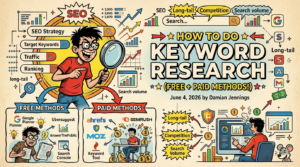
Start free. Google’s autocomplete shows what people actually search. The “People also ask” box surfaces related questions. Google Search Console (free, covers your own site already) shows what you’re already being found for and what you’re close to ranking for. These three tools together will tell you more than any paid keyword tool in the first six months.
When evaluating a keyword, look at what’s already ranking for it. If the top ten results are all major national brands with ten-year-old domains, that’s not where a small business starts. Look for gaps where the existing content is weak, generic, or aimed at a different audience. That’s where you compete.
Intent beats volume. A keyword with 100 monthly searches from people ready to buy is worth more than one with 10,000 searches from people after free information. Understand what the person searching actually wants — to buy, to learn, to compare, to find a local service — and make sure your content delivers exactly that.
On-page SEO in practice
For each page you want to rank, the process is the same even if the execution takes effort. Your page title (H1) and meta title (what appears in search results) should both include the primary keyword naturally. Not stuffed awkwardly — naturally. “Emergency Plumber Leeds — Available 24/7” is better than “We Offer Plumbing Services in the Leeds Area Including Emergencies.”
Your meta description doesn’t directly affect rankings, but it heavily affects click-through rate. Write it like an ad — make it compelling enough that someone scanning search results wants to click yours over the four results around it.
Structure your content with clear headings. H2 for main sections, H3 for subsections. This helps both readers and Google understand what the page covers. Use your target keyword and related terms in the copy, naturally and in context. Cover the topic thoroughly enough that someone who arrives actually gets what they came for and doesn’t immediately hit back to look elsewhere — because that bounce signal is something Google watches.
Internal links matter more than most people realise. Linking between your own pages passes authority, helps Google understand the relationship between your content, and keeps readers on the site. Build a deliberate internal linking structure rather than leaving it to chance.
What actually moves rankings
Content quality — genuine, specific, useful content that actually answers what the searcher is looking for — matters more than it ever has. Google’s helpful content updates have been systematically downgrading generic, thin content. The bar for “good enough” has risen considerably.
E-E-A-T (Experience, Expertise, Authoritativeness, Trustworthiness) describes what Google is looking for when assessing content quality. Content that demonstrates real-world experience, written by an identifiable expert, on a site with a track record of accuracy, consistently outperforms generic content on the same topic — even when the generic content is technically well-optimised.
Keywords still matter, but use them naturally. Cover the topic thoroughly enough that someone who lands on your page gets what they came for. Authority takes time to build — a new domain ranks for fewer things than an established one. This is why SEO is a long game. You’re building an asset, not flipping a switch.
Building links without it being a full-time job
Link building has a reputation for being either expensive or spammy. The middle ground — earning links through content that’s genuinely worth linking to — is more achievable than most businesses assume.
The most reliable approach: create one piece of content that’s genuinely better than everything else on a topic. Not longer — better. Original data, real expertise, an unusually thorough treatment of the subject. This is what earns links. One piece that earns twenty links from relevant sites does more for your SEO than twenty posts that earn nothing.
Industry directories, local business associations, Chamber of Commerce listings, local press, supplier pages, partner websites — these are all legitimate sources most businesses overlook. Being quoted in industry publications earns links. PR earns links. Guest posts on genuinely relevant sites earn links.
What to avoid: paid link schemes, directory spam, and “I’ll link to you if you link to me” arrangements. Google’s algorithm has become increasingly good at identifying and discounting these, and a manual penalty for unnatural links is painful to recover from.
How to measure whether it’s working
The two essential tools are free. Google Search Console shows your rankings, impressions, and click-through rates for every keyword Google has found you for. Google Analytics shows how much organic traffic you’re receiving and what that traffic does when it arrives — conversions, time on site, pages visited.
Watch these metrics: total organic sessions (trend over three months, not individual days), ranking positions for your target keywords, click-through rate from Search Console, and conversions from organic traffic. Rankings fluctuate daily — the signal is in the trend over months, not the noise in the day-to-day.
Realistic timelines
3–6 months: technical fixes, initial content, early indexing. Very little traffic yet.
6–12 months: rankings start to appear for lower-competition terms. Traffic begins to grow.
12–24 months: meaningful organic traffic for competitive terms. The compounding becomes visible.
24 months onwards: a well-maintained SEO strategy starts to generate traffic that’s genuinely hard for competitors to displace quickly.
| Timeline | What to expect | What to focus on |
|---|---|---|
| 0–3 months | Almost no visible results | Technical setup, Search Console, first content |
| 3–6 months | Early rankings on long-tail terms | Content expansion, fixing crawl issues |
| 6–12 months | Steady traffic growth | Link building, content gaps |
| 12–24 months | Competitive terms moving up | Authority building, content depth |
| 24+ months | Compounding returns | Maintaining quality, expanding coverage |
DIY, agency, or freelancer?
| DIY | Freelancer | Agency | |
|---|---|---|---|
| Cost | Your time only | £500–£2,000/month | £1,500–£5,000+/month |
| Speed | Slow (learning curve) | Medium | Medium to fast |
| Quality ceiling | Limited by your capacity | High if well-chosen | Variable — depends heavily on who works your account |
| Best for | Low-competition niches, very tight budgets | Most small businesses | Complex sites, national or high-competition markets |
What SEO is not
It’s not a one-time project. It’s not a set of tricks to game the algorithm. It’s not something that can be outsourced to someone who guarantees rankings — nobody can guarantee rankings, because Google’s algorithm is not within anyone’s control. And it’s not separate from having genuinely good content. The businesses that do SEO well are, almost without exception, the businesses that are also investing in being genuinely useful to their audience.
How long does SEO take to work?
Most businesses see initial results — early rankings on low-competition terms — within three to six months. Meaningful traffic from competitive terms typically takes twelve to twenty-four months. This varies based on domain age, existing content, competition level, and how consistently you invest.
How much does SEO cost?
DIY SEO costs your time. A competent freelancer typically charges £500–£2,000 per month depending on scope. A full-service agency charges £1,500–£5,000+ per month. For most small businesses in low-to-medium competition niches, a good freelancer or a focused DIY approach is the most cost-effective starting point.
Can I do SEO myself?
Yes, with caveats. Setting up Search Console, doing keyword research, writing good content, and getting local listings sorted are all learnable without specialist help. Technical SEO and link building at any scale is where most business owners hit a ceiling. Start with what you can do, bring in help for what you can’t.
What’s the difference between SEO and paid ads?
SEO earns traffic over time; paid ads buy traffic immediately. When you stop paying for ads, the traffic stops. When you stop investing in SEO, the traffic carries on — for a while. They’re complementary, not competing: many businesses use ads to fill the gap while SEO compounds. SEO is the better long-term investment; ads are better for speed and testing.
Is SEO worth it for a small business?
In most cases, yes. The caveat is if you’re in a niche so competitive that ranking requires years of significant investment — the ROI calculation changes. For most small businesses targeting local or niche queries, a modest and consistent SEO investment over twelve to twenty-four months produces returns that outperform most other marketing channels.
How do I know if my SEO is working?
Check Google Search Console monthly: are impressions and clicks growing? Are your target keywords moving up? Check Google Analytics: is organic traffic increasing? Are organic visitors converting? Don’t judge week-to-week — look at three-month rolling trends.