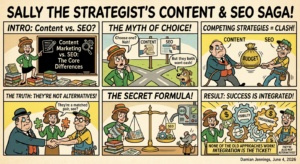

Content marketing is the practice of creating genuinely useful things — articles, videos, guides, tools — that attract the people you want as customers, build trust with them over time, and eventually turn that trust into business.
It’s a long game. It doesn’t work if you need customers next week. But for businesses thinking about where they want to be in two years, it’s one of the highest-return marketing investments available — and unlike most of the alternatives, the assets it creates keep working long after you’ve stopped actively investing in them.
What it actually is, and isn’t
It’s not just blogging. It’s not posting on LinkedIn three times a week and waiting. Done properly, content marketing is a strategic approach to being consistently useful to your target audience across multiple formats and channels: written content, video, podcasts, email, social, and the occasional tool or resource they can actually use.
The word “strategic” matters. Random content creation produces random results. Content planned around what your audience needs to know, at each stage of their journey from not-knowing-you-exist to becoming-a-customer, is how it actually works.
Why it works — the trust compound
Most people don’t buy the first time they encounter a brand. They research, compare, forget about it, come back, read something you wrote, and eventually decide. Content marketing fills that gap. It keeps you present and credible across all those touchpoints without requiring you to interrupt anyone.
The compounding is real. A guide you publish this year can drive traffic and generate leads three years from now. A paid ad you ran three years ago is long gone. The library of content builds over time into an asset that works independently of whether you’re actively spending on marketing this month.
Which format to start with
The right format is the one your audience actually consumes and the one you can produce consistently. Both conditions need to be true. A brilliant video strategy is worthless if you hate being on camera and it never gets made.
Written content (blog posts, guides, articles) is the most durable and SEO-friendly format. It can be repurposed easily into social posts, email newsletters, and scripts. It’s also the most searchable — text is what search engines index. For most small businesses without a dedicated marketing team, written content is the right starting point.
Video is the highest-engagement format and increasingly important for discoverability on YouTube and social platforms. If you’re comfortable on camera or have something that’s better demonstrated than explained, video earns its overhead. The biggest mistake is treating it as separate from the rest of your content — the same material that makes a good article usually makes a good video, and vice versa.
Podcasting builds deep audience relationships and strong authority positioning, but it’s a slow burn. The audience builds gradually and monetisation is indirect. It’s a strong format for established businesses looking to deepen relationships with an existing audience rather than for businesses at the awareness-building stage.
How to plan content that actually gets made
Start with questions, not topics. What do your customers ask you most often? What do they misunderstand? What do they need to know before they’re ready to buy? These are the foundations of a content plan that serves a real audience rather than filling space.
A simple system: keep a running list of every question a customer or prospect asks you. Review it monthly and turn the most common or highest-value questions into content. This approach never runs dry, produces content people are actively searching for, and stays naturally relevant to your actual customers.
Consistency beats frequency. One article a month published reliably for two years produces better results than one week of ten articles followed by silence. Set a cadence you can sustain over twelve months without burning out, then protect it.
Distribution — content doesn’t market itself
Publishing content is not the same as getting it in front of people. A new piece of content starts with zero audience. You have to distribute it actively, at least until you’ve built enough organic authority that search traffic arrives reliably.
The most efficient distribution system: publish the article, send it to your email list (even a small one), share it on the social channels where your audience actually is, and look for opportunities to link to it from older content on your own site. This four-step system works for any business with any size audience and ensures every piece gets a genuine distribution push rather than just being published and forgotten.
Search is the distribution channel that compounds. Once a piece ranks, the traffic is free and grows over time. Social and email traffic spikes at publication and then fades. Both matter, but the long-term investment is in content good enough to rank.
How to measure content marketing
The right metrics depend on what you’re trying to achieve, but the most useful are: organic traffic (is more of it arriving month-on-month?), rankings for target keywords, email list growth driven by content, and leads or sales attributed to organic traffic. Vanity metrics — social shares, page views without context, raw visitor counts — tell you very little about whether the content is doing useful commercial work.
Set up goal tracking in Google Analytics before you start publishing. Knowing that organic traffic converts at 2% is more useful than knowing you have 10,000 monthly visitors.
Realistic timelines
0–3 months: creation and publication. Very little to show for it yet. This is where most people give up, and it’s exactly the wrong time to do so.
3–6 months: early organic traffic. Content starts appearing in search results. Audience begins to grow, slowly.
6–12 months: real traction. Some pieces start driving meaningful traffic. Email list grows from the content. You have enough data to know what’s working.
12 months onwards: the compounding becomes visible. Each piece builds on the authority of everything before it.
Content marketing vs the alternatives
| Content marketing | Paid ads | Social only | |
|---|---|---|---|
| Time to results | 6–18 months | Days | Slow and inconsistent |
| Long-term cost | Decreases as library grows | Stays constant | High in time |
| What happens when you stop | Assets keep working | Traffic stops immediately | Visibility drops |
| Trust built | High, earned over time | Low, interruption-based | Medium |
| SEO benefit | High | None | Minimal |
Where to start
Pick the questions your customers ask you most often. You know these cold — you answer them every week. Write genuinely good answers. Publish them somewhere they can be found. Repeat, consistently, over a long enough period for the compounding to kick in.
It’s not complicated. It’s just slow, which is why most businesses underinvest in it and then wonder why their competitors have better organic visibility two years later.
How often should I publish content?
Often enough to maintain momentum, not so often that quality suffers. For most small businesses, one substantial piece per month is more valuable than four thin ones. Consistency over time matters more than frequency in any given month. Publish on a schedule you can sustain for eighteen months without it becoming a burden.
Does content marketing work for small businesses?
Yes — arguably better than for large businesses, because you can demonstrate genuine personal expertise and local knowledge that corporate content can’t replicate. The businesses that do it best are the ones where a real expert is writing from direct experience. That’s easier to achieve in a small business than in a corporation producing committee-approved content.
How long should a blog post be?
Long enough to fully answer the question, short enough that it doesn’t include padding. The right length varies completely by topic — a comprehensive guide to keyword research might need 3,000 words; a clear answer to “what is a meta description” might need 400. Don’t target word counts. Target thoroughness.
How do I measure whether content marketing is working?
Track organic traffic in Google Analytics (is it growing month-on-month?), rankings for your target keywords in Google Search Console (are you moving up?), and conversions from organic traffic (are visitors doing something useful?). Also watch email list growth if you’re using content to build a list. Review the trends quarterly rather than monthly — content marketing moves slowly enough that week-to-week analysis produces mostly noise.
Should I write content myself or hire someone?
If you have genuine expertise and can write clearly, do it yourself — at least initially. Your direct experience and knowledge is an asset that freelancers can’t fully replicate. Where freelancers add value is in researching, drafting, editing, and handling the structural work, while you provide the subject matter knowledge and final review. The worst content comes from briefing someone to write about your industry without giving them access to your actual expertise.