
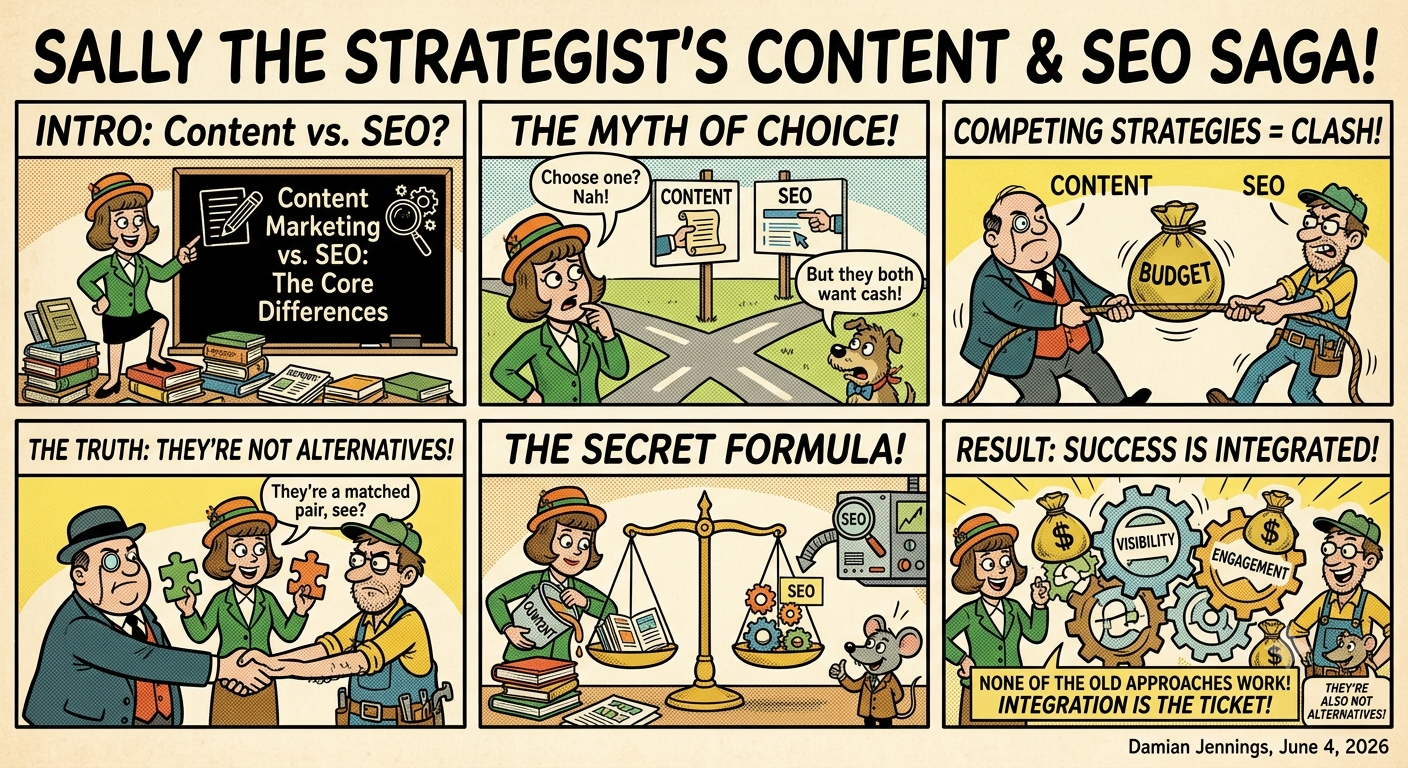
A lot of businesses treat content marketing and SEO as competing strategies. They allocate budget to one and not the other, or keep them in separate teams that don’t speak, or decide they’re “doing SEO” and skip content entirely. None of these approaches work particularly well.
They’re not the same thing. They’re also not alternatives.
What SEO is
SEO (search engine optimisation) is the work of making your website and content more likely to appear in search results. That covers technical foundations (site speed, crawlability, structured data), on-page work (keyword targeting, title tags, internal linking), and off-page signals (backlinks, brand mentions, citations). The core job is discoverability: making sure that when someone searches for something you do, you show up.
What content marketing is
Content marketing is the work of creating useful, relevant things (articles, videos, guides, tools) that attract people you want as customers and build trust with them before they’re ready to buy. The content isn’t an ad. It’s something genuinely useful that earns attention and keeps your brand present across the whole buying journey, not just the last click.
Why each one fails without the other
Content marketing without SEO produces content nobody finds. The most useful guide in your industry, sitting on a slow domain with no authority and no keyword targeting, gets essentially zero organic traffic. You’re creating for an audience that doesn’t know you exist.
SEO without content gives you rankings for pages that don’t help anyone. You can optimise a thin page for a keyword, but if people land on it and immediately leave because it doesn’t answer what they came for, you get high bounce rates, no conversions, and eventually, rankings that slip, because Google notices when visitors don’t stick around.
Content gives you something worth ranking. SEO makes sure it actually ranks.
Where people get confused
The phrase “SEO content” doesn’t help. For some people it means thin, keyword-stuffed articles that exist purely to appear in search results, which is bad content marketing and increasingly bad SEO. For others it means content deliberately crafted to rank, which should just be… good content that’s also properly optimised.
The distinction matters because it shapes behaviour. If you think “SEO content” means gaming the algorithm, you’ll write for machines. If you understand that the best-ranking content is usually the most genuinely useful content, you write for people, and the SEO follows from that.
How to think about both together
Start with what your audience needs to know. Not with what keywords you want to rank for, with what questions they’re actually asking and what problems they’re trying to solve. Then check whether people are searching for that. If there’s search volume, great. If there isn’t, you might still write it for other reasons, but don’t expect organic traffic to show up.
Write the best answer to the question that exists. Not the longest, not the most keyword-dense, the most genuinely useful. Then spend twenty minutes on the SEO layer: title tag, meta description, URL, headings, internal links. That’s it. If the content is good, the optimisation takes very little time.
On budget
If someone is asking whether to spend on “content marketing” or “SEO,” the question itself is the problem. The work that creates good content and the work that gets it to rank are the same work. Treating them as separate line items creates silos that produce worse results than integrating them, and usually means paying twice for things that should be done once.